Viral glycoproteins are often the only antigen found on the viral surface and, as such, are key targets for neutralizing antibodies. Analyzing the type and affinity of the different molecular interactions that can occur is essential for understanding what makes a good neutralizing antibody and how these interactions can be utilized in postexposure treatments as well as vaccine development.
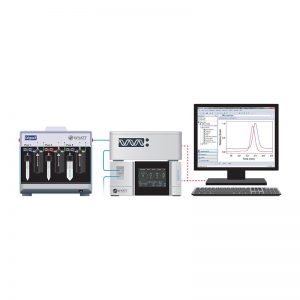
To this end, we first used size-exclusion chromatography coupled with multi-angle light scattering (SEC-MALS) to determine the molar mass and native oligomeric state of a viral glycoprotein (vGP). In addition, MALS measured by the miniDAWN was combined with simultaneous concentration measurements by UV and dRI (Optilab) to measure the glycan content of the vGP using Protein Conjugate Analysis.
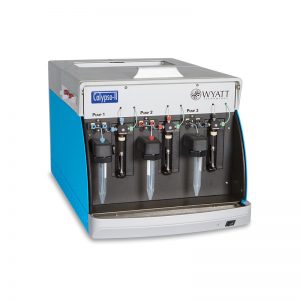
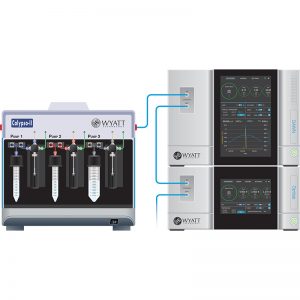
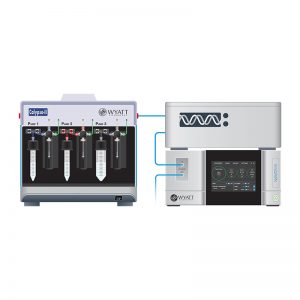
Next, we employed composition-gradient multi-angle light scattering (CG-MALS) with the Wyatt Calypso® and miniDAWN® to determine the stoichiometry and affinity of the glycoprotein:antibody interaction. The automated Calypso method consisted of a concentration gradient of glycoprotein to assess self-association properties as indicated by SEC-MALS and a dual-composition “crossover” gradient to assess hetero-association behavior.
The light scattering data were best fit in the CALYPSO® software by an association model that accounts for two equivalent glycoprotein binding sites per antibody molecule and a meta-complex of two IgGs bound two dimers. Surprisingly, a model that provided for up to two antibody-binding sites on a single vGP dimer did not fit the data, suggesting the single epitope may lie near the dimeric interface.