Therapeutic insulin analogs, engineered for specific states of self-association, have revolutionized the treatment of diabetes mellitus. Modifications that impact the selfassociation of these molecules in turn alter their pharmacokinetics and pharmacodynamics, resulting in fast-acting drugs best suited for prandial regimens and insulin pumps or extended-release versions for once daily dosage. Hence the ability to quantify the affinity and stoichiometry of insulin self-association is central to developing efficacious analogs.
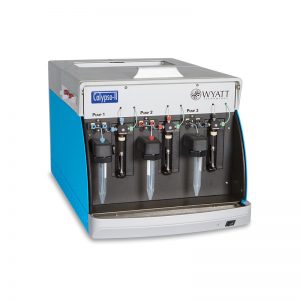
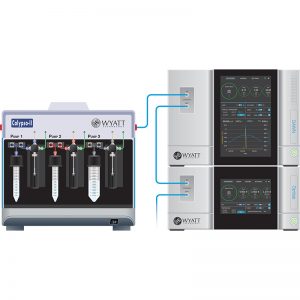
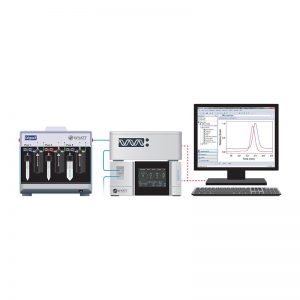
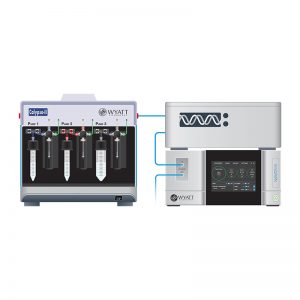
In this note, we quantify the self-association of insulin at neutral pH in the absence of Zn2+ using composition-gradient multi-angle light scattering (CG-MALS). CG-MALS enables rapid, reproducible, label-free quantification of biomolecular self-association. The increase in weightaverage molar mass as a function of concentration is fit to an appropriate association model to yield the absolute stoichiometry and affinity of the interactions.
Under these conditions, insulin undergoes isodesmic selfassociation. Monomers self-associate to form dimers, trimers, and all higher order complexes. Each monomer adds to the growing cluster with equivalent affinity, in this case Kd = 52 µM. At the maximum concentration tested (3.2 mg/mL, 536 µM), an adequate description of the insulin solution must include oligomers >10-mer.