Interactions between proteins and nucleic acids often result in binding stoichiometries greater than 1:1 and may exhibit cooperativity, allosteric hindrance, or other complex phenomena. Quantifying the affinity and stoichiometry of these biomolecular assemblies is key to understanding the mechanism of interaction and to developing therapeutics that target and modulate them.

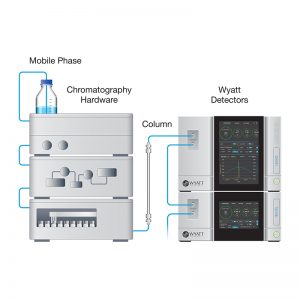
Here, we present the characterization of protein-DNA complexes using two complementary multi-angle light scattering (MALS) techniques: 1) in combination with size exclusion chromatography (SEC-MALS) and protein conjugate analysis to measure the overall complex molar mass and fraction of DNA and 2) composition-gradient MALS (CG-MALS) to quantify the stoichiometry and affinity at each binding site in the complex formation.

Calypso II CG-MALS

Calypso II CG-MALS

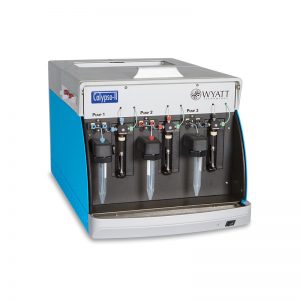
Label-free, immobilization-free characterization of protein-protein and other macromolecular interactions with composition-gradient multi-angle light scattering.

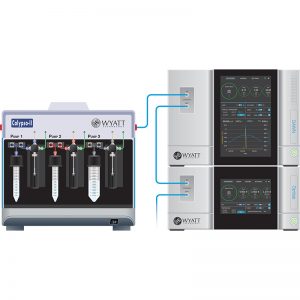
The Calypso® II, in conjunction with a DAWN® or miniDAWN® MALS detector, measures binding affinities and absolute, molecular stoichiometries of complex biomolecular interactions.

DAWN®

DAWN®

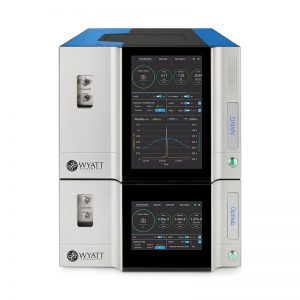
The world’s most advanced light scattering instrument for absolute characterization of proteins, conjugates, macromolecules, and nanoparticles.

The DAWN and its companion Optilab dRI detector are the established benchmarks for MALS analysis, cited in thousands of peer-reviewed publications. Multi-angle light scattering detection is indispensable for use with GPC and HPLC-SEC in order to obtain reliable molecular mass distributions and information on molecular conformation, branching ratio, fragments and aggregates.