The Yersinia pestis injectosome is a multi-protein apparatus that transfers bacterial virulence factors into targeted host phagocytes. This is an essential part of plague pathogenesis and contributes to the evasion of mammalian immune defenses. The Y. pestis injectosome consists of a basal structure, the type III secretion system (T3SS) spanning both membranes of the bacterial envelope, upon which assembles a hollow needle-like structure. On specific adhesion and docking with a phagocyte, the injectosome transfers a set of secreted anti-host effector proteins called Yersinia outer proteins (Yops) directly into the host cell, some of which prevent bacterial engulfment and block the normal production of proinflammatory cytokines. Genetic regulation of these virulence factors is known to include heat-inducible and calcium-repressible pathways, so that their production increases at 37°C and by dilution of solution calcium to less than millimolar content—the low calcium response (lcr). The gene products LcrG and LcrV comprise an important part of a proposed molecular gate which controls the efflux of Yops and allows their release only after successful docking with the host cell. The biochemical mechanism of gating the transfer of Yops is not yet understood, but is also suggested to involve calcium.
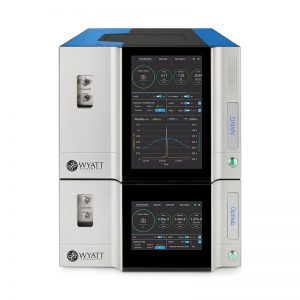
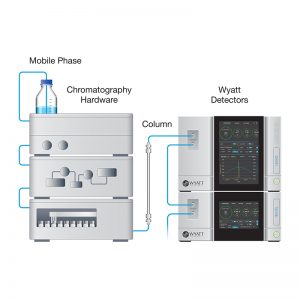
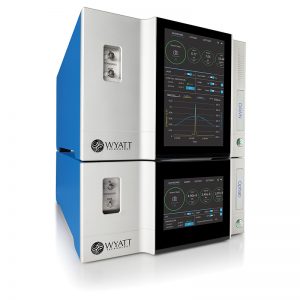
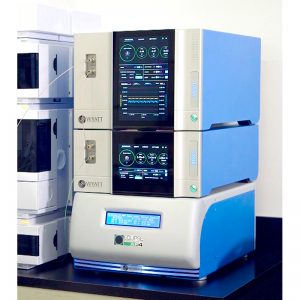
Analytical size exclusion chromatography coupled to absolute molar mass measurement by multi-angle light scattering (SEC-MALS) with a DAWN multi-angle light scattering (MALS) detector demonstrates that each of these component proteins exhibits its predicted molar mass at 37°C, including purified monomeric and dimeric forms of LcrV.