Complex interactions between proteins modulate the rotational direction of bacterial flagella. In particular, the middle and C-terminal domains of FliG (FliGM and FliGC, respectively) bind two different sites on the binding partner FliM, as part of the flagellar motor switch. We extend previous nuclear magnetic resonance (NMR) studies of the interactions between FliG domains with FliM via composition-gradient multi-angle static light scattering (CG-MALS) to confirm specific binding, quantify affinities, and identify the stoichiometries of complexes formed.

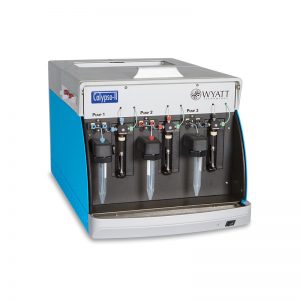
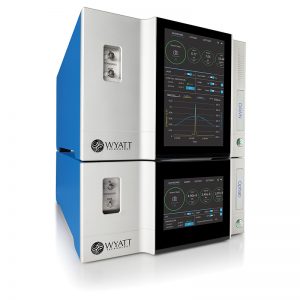
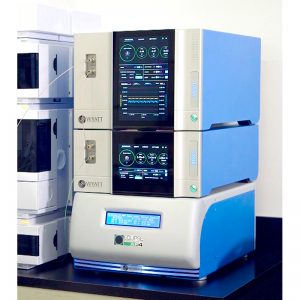
Calypso II CG-MALS

Calypso II CG-MALS

Label-free, immobilization-free characterization of protein-protein and other macromolecular interactions with composition-gradient multi-angle light scattering.

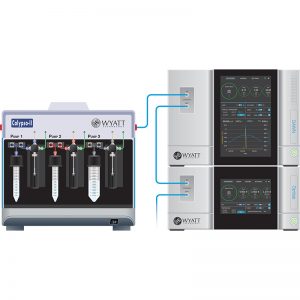
The Calypso® II, in conjunction with a DAWN® or miniDAWN® MALS detector, measures binding affinities and absolute, molecular stoichiometries of complex biomolecular interactions.

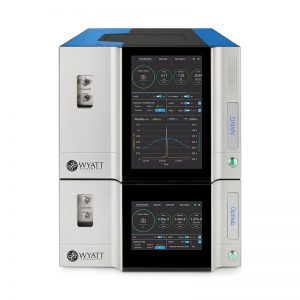
DAWN®

DAWN®

The world’s most advanced light scattering instrument for absolute characterization of proteins, conjugates, macromolecules, and nanoparticles.

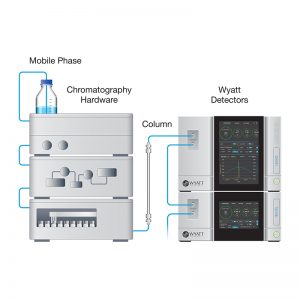
The DAWN and its companion Optilab dRI detector are the established benchmarks for MALS analysis, cited in thousands of peer-reviewed publications. Multi-angle light scattering detection is indispensable for use with GPC and HPLC-SEC in order to obtain reliable molecular mass distributions and information on molecular conformation, branching ratio, fragments and aggregates.

Optilab

Optilab

Universal Detection for Chromatography and FFF Separations

Using a combination of cutting-edge semiconductor photodiode technology and proprietary computer algorithms, the Optilab achieves an unprecedented combination of sensitivity and range. These features mean that it addresses both standard chromatographic applications and some challenges unique to light scattering measurements such as high concentrations, determination of sample refractive increments (dn/dc) and solvent refractive index.