This white paper provides a brief overview of the basic principles of the detection and characterization of polymer branching by means of multi-angle light scattering (MALS). The most common methods for determining branching parameters are presented and elucidated by means of pertinent experimental results. The abnormal elution behavior of certain branched macromolecules in size exclusion chromatography (SEC) is explained and the data acquired by SEC-MALS are compared with those obtained by asymmetric-flow field flow fractionation (AF4). The comparison of SEC-MALS and AF4-MALS proves superior separation of large and highly branched macromolecules by AF4 compared to SEC. The addition of MALS capabilities is invaluable for analyzing branched polymers.

DAWN®

DAWN®

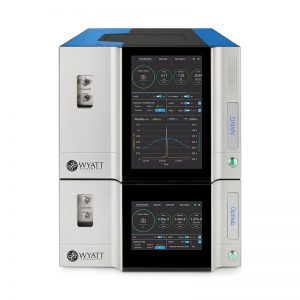
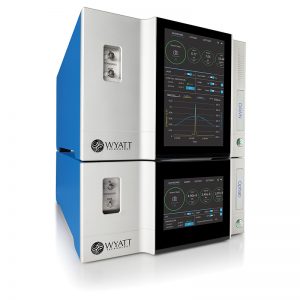
The world’s most advanced light scattering instrument for absolute characterization of proteins, conjugates, macromolecules, and nanoparticles.

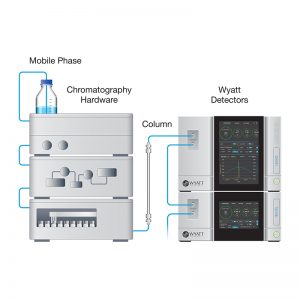
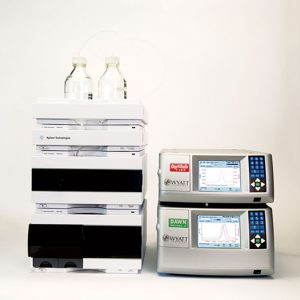
The DAWN and its companion Optilab dRI detector are the established benchmarks for MALS analysis, cited in thousands of peer-reviewed publications. Multi-angle light scattering detection is indispensable for use with GPC and HPLC-SEC in order to obtain reliable molecular mass distributions and information on molecular conformation, branching ratio, fragments and aggregates.

Eclipse AF4

Eclipse AF4

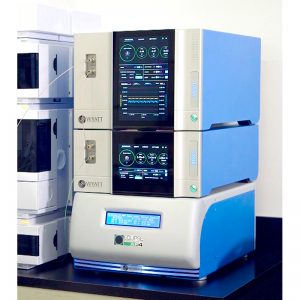
Versatile separations of polymers, proteins, colloids, and nanoparticles.

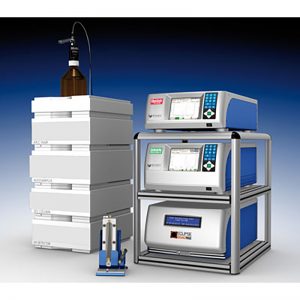
The Eclipse™ AF4 supports all AF4 techniques except Hollow-Fiber Flow Field-Flow Fractionation (HF5), which is covered by the Eclipse DualTec. However, the Eclipse AF4 supports the fritless AF4 channel which prevents the difficulties encountered by certain samples prone to aggregation at the relatively high concentrations typical of the AF4 focusing step. It also supports the semi-preparative channel.

Optilab

Optilab

Universal Detection for Chromatography and FFF Separations

Using a combination of cutting-edge semiconductor photodiode technology and proprietary computer algorithms, the Optilab achieves an unprecedented combination of sensitivity and range. These features mean that it addresses both standard chromatographic applications and some challenges unique to light scattering measurements such as high concentrations, determination of sample refractive increments (dn/dc) and solvent refractive index.