Lignin is the second most abundant natural polymer and a major constituent of green plants. In contrast to cellulose, it has no industrial/technical use except incineration for energy production. In view of the push for sustainability, efforts to find new ways for utilization of lignin have been increasing and more research is devoted to finding productive applications.

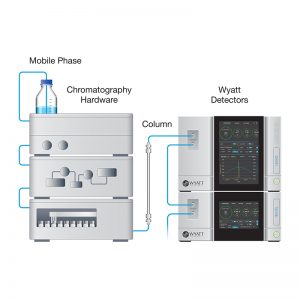
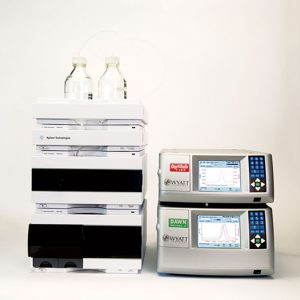
The most fundamental property of biopolymers is their molar mass distribution. Originally, lignin was assumed to be a very large macromolecule that provides support for cellulose in cell walls; then there seemed to be evidence that it is merely an oligomer consisting of a few monomer units. A significant breakthrough in the molar mass characterization of lignin and its derivative lignosulfonate was achieved by coupling the DAWN® online multi-angle light scattering (MALS) instrument to size-exclusion chromatography (SEC) or the EclipseTM field-flow fractionation (FFF) device.

DAWN®

DAWN®

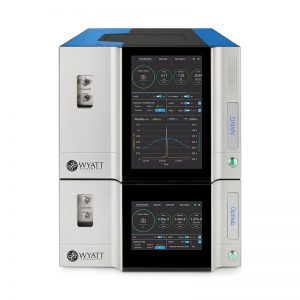
The world’s most advanced light scattering instrument for absolute characterization of proteins, conjugates, macromolecules, and nanoparticles.

The DAWN and its companion Optilab dRI detector are the established benchmarks for MALS analysis, cited in thousands of peer-reviewed publications. Multi-angle light scattering detection is indispensable for use with GPC and HPLC-SEC in order to obtain reliable molecular mass distributions and information on molecular conformation, branching ratio, fragments and aggregates.

Eclipse AF4

Eclipse AF4

Versatile separations of polymers, proteins, colloids, and nanoparticles.

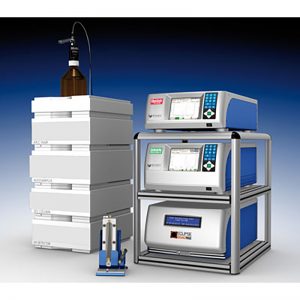
The Eclipse™ AF4 supports all AF4 techniques except Hollow-Fiber Flow Field-Flow Fractionation (HF5), which is covered by the Eclipse DualTec. However, the Eclipse AF4 supports the fritless AF4 channel which prevents the difficulties encountered by certain samples prone to aggregation at the relatively high concentrations typical of the AF4 focusing step. It also supports the semi-preparative channel.