Cellulose, a biopolymer of great importance to the fiber and paper industries, is difficult to characterize because of its high molar mass. Its intractable nature means it cannot be dissolved in conventional solvents without chemical modification. With tedious effort, it can be modified so that it can be dissolved in an easy-to-use solvent like THF, but when the cellulose is so-modified it is degraded and the analysis does not represent the source material.

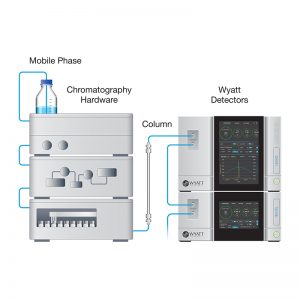
Unmodified cellulose can be dissolved in dimethyl acetamide (DMAC) with LiCl added. The problem remains, how to characterize it without reference to column calibration standards that typically do not have the same conformation as cellulose and therefore do not provide accurate calibration curves. Absolute characterization is performed by combining multi-angle light scattering with size exclusion chromatography (SECMALS) to determine molar mass, independently of elution standards.

DAWN®

DAWN®

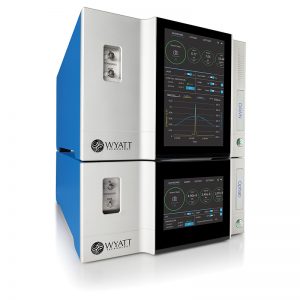
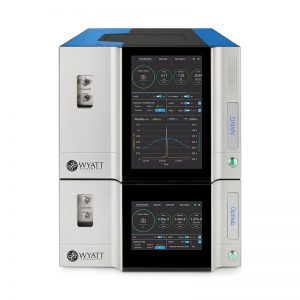
The world’s most advanced light scattering instrument for absolute characterization of proteins, conjugates, macromolecules, and nanoparticles.

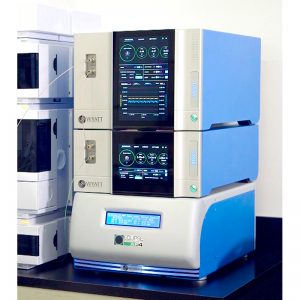
The DAWN and its companion Optilab dRI detector are the established benchmarks for MALS analysis, cited in thousands of peer-reviewed publications. Multi-angle light scattering detection is indispensable for use with GPC and HPLC-SEC in order to obtain reliable molecular mass distributions and information on molecular conformation, branching ratio, fragments and aggregates.

Optilab

Optilab

Universal Detection for Chromatography and FFF Separations

Using a combination of cutting-edge semiconductor photodiode technology and proprietary computer algorithms, the Optilab achieves an unprecedented combination of sensitivity and range. These features mean that it addresses both standard chromatographic applications and some challenges unique to light scattering measurements such as high concentrations, determination of sample refractive increments (dn/dc) and solvent refractive index.