The chemical composition of a copolymer material has a substantial impact on its properties and performance. Defining a composition profile is therefore an essential aspect of copolymer product development. Since copolymer composition often varies considerably with molecular weight (MW), a detailed analysis is required in copolymer R&D.
Traditional polymer characterization techniques such as size exclusion chromatography coupled with differential refractive index detection (SEC-dRI) or nuclear magnetic resonance (NMR) are either insufficient to perform a comprehensive analysis, or involve significant labor, complexity and/or cost.
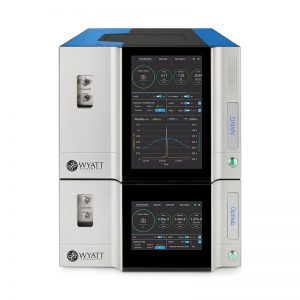
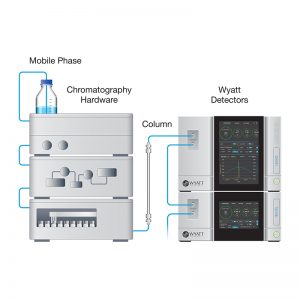
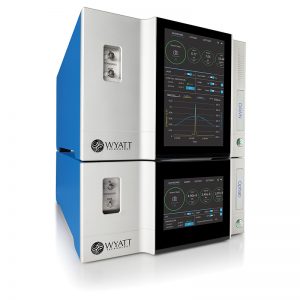
This application note demonstrates how both the absolute molecular weight and composition of random-copolymer samples with a UV-absorbing component may be determined quickly and accurately, without a fraction collection step or NMR analysis. The technique utilizes size exclusion chromatography combined with analysis by three on-line detectors: multi-angle light scattering, differential refractive index and UV/Vis absorbance (SECUV-MALS-dRI). Weight fractions of poly(styrene-co-acrylic acid) (PSAA) samples were analyzed using the tripledetector system and ASTRA® software for macromolecular characterization. Results were found to be in good agreement with the reference values determined by 1H NMR spectroscopy.