There has been a significant resurgence in the development of antibody-drug conjugates (ADC) as targetdirected therapeutic agents for cancer treatment. Among the factors critical to effective ADC design is the drug-antibody ratio (DAR), which describes the degree of drug appended to the antibody and directly impacts
both potency and potential toxicity of the therapeutic. In addition to therapeutic/physiological effects, DAR can also affect drug product properties such as stability and aggregation. Determination of DAR is, therefore, of critical importance in the development of novel ADC therapeutics.
DAR is typically assessed by mass spectrometry (MALDITOF or ESI-MS) or UV spectroscopy, both of which are subject to certain limitations:
1) calculations based on UV absorption are often complicated by similarities in extinction coefficients of the antibody and small molecule;
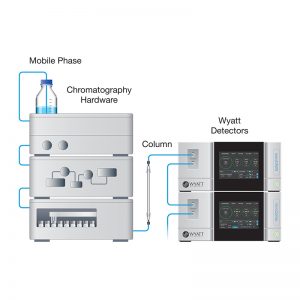
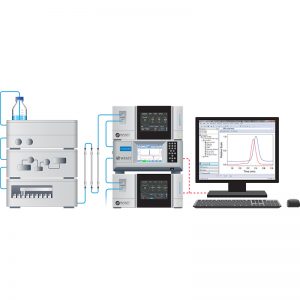
2) mass spectrometry, though a powerful tool for molecular weight determination, depends on uniform ionization and recovery between compounds—which is not always the case for ADCs. We present here a method for DAR determination based on SEC-MALS in conjunction with UV absorption and differential refractive index (dRI) detection, which overcomes these limitations for many ADCs.