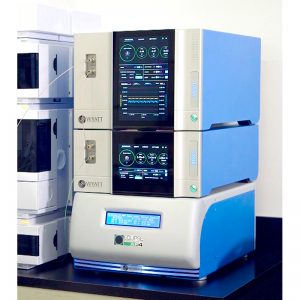
Analysis of purity and demonstration of lot to lot comparability is essential throughout the drug development process. Among the various biophysical and biochemical assessments of purity to which biological therapeutics are subjected, one of the most fundamental is based on the molecular weight of the species present in aqueous solution.

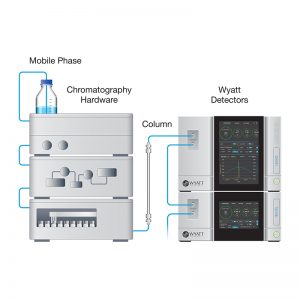
A common approach to evaluate the relative levels of molecular weight forms is to perform analytical size exclusion chromatography (SEC) in combination with multi-angle light scattering (MALS) and absorbance (UV) and/or refractive index (RI) concentration detectors. For monoclonal antibodies, a dominant peak (>95% total peak area and molar mass consistent with an intact antibody) along with a small number of minor high and/or low molecular weight species is frequently observed. While SEC-MALS data are robust and precise, the method is not without potential concerns. Sample dilution, weak non-specific interactions with the column, shearing, or exclusion of high molecular weight species are frequently cited effects that may impact the complete analytical characterization of purity based on size fractionated material.

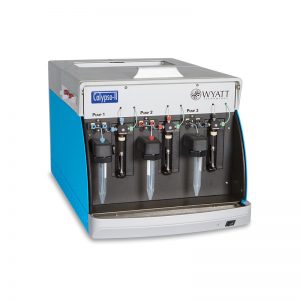
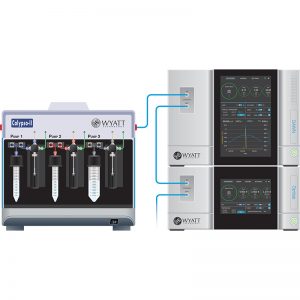
Calypso II CG-MALS

Calypso II CG-MALS

Label-free, immobilization-free characterization of protein-protein and other macromolecular interactions with composition-gradient multi-angle light scattering.

The Calypso® II, in conjunction with a DAWN® or miniDAWN® MALS detector, measures binding affinities and absolute, molecular stoichiometries of complex biomolecular interactions.

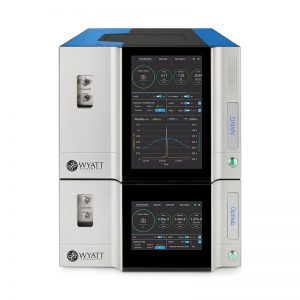
DAWN®

DAWN®

The world’s most advanced light scattering instrument for absolute characterization of proteins, conjugates, macromolecules, and nanoparticles.

The DAWN and its companion Optilab dRI detector are the established benchmarks for MALS analysis, cited in thousands of peer-reviewed publications. Multi-angle light scattering detection is indispensable for use with GPC and HPLC-SEC in order to obtain reliable molecular mass distributions and information on molecular conformation, branching ratio, fragments and aggregates.

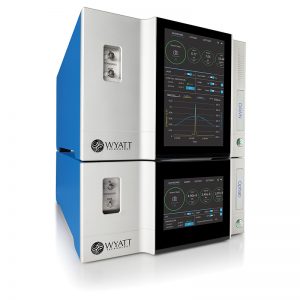
Optilab

Optilab

Universal Detection for Chromatography and FFF Separations

Using a combination of cutting-edge semiconductor photodiode technology and proprietary computer algorithms, the Optilab achieves an unprecedented combination of sensitivity and range. These features mean that it addresses both standard chromatographic applications and some challenges unique to light scattering measurements such as high concentrations, determination of sample refractive increments (dn/dc) and solvent refractive index.