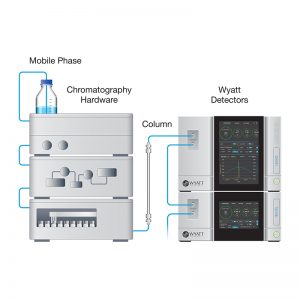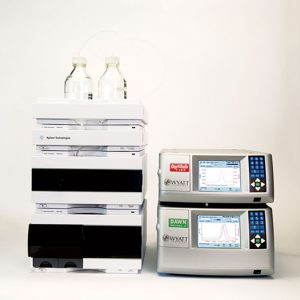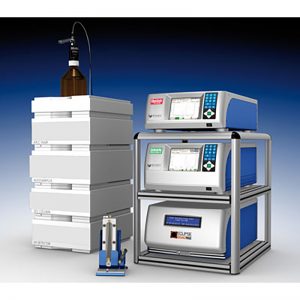
Much attention has been paid to biodegradable nanoparticle systems. It is well known that parameters such as particle size and shape are important for blood circulation time. We used the methods of Photon Correlation Spectroscopy (PCS) and Asymmetrical Flow – Field Flow Fractionation (FFFF) to assess sizes of biodegradable nanoparticles.

The systems used were colloidal aqueous suspensions of nanospheres consisting of the biodegradable polyester Resomer RG 503 (0.5% w/v). The particles were produced using the solvent deposition method. To check the validity of the F-FFF method, particles with different sizes were produced by increasing the injection velocity of the acetone-polymer solution into the water.

DAWN®

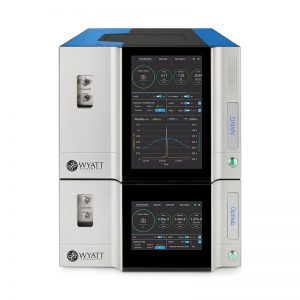
DAWN®

The world’s most advanced light scattering instrument for absolute characterization of proteins, conjugates, macromolecules, and nanoparticles.

The DAWN and its companion Optilab dRI detector are the established benchmarks for MALS analysis, cited in thousands of peer-reviewed publications. Multi-angle light scattering detection is indispensable for use with GPC and HPLC-SEC in order to obtain reliable molecular mass distributions and information on molecular conformation, branching ratio, fragments and aggregates.

Eclipse AF4

Eclipse AF4

Versatile separations of polymers, proteins, colloids, and nanoparticles.

The Eclipse™ AF4 supports all AF4 techniques except Hollow-Fiber Flow Field-Flow Fractionation (HF5), which is covered by the Eclipse DualTec. However, the Eclipse AF4 supports the fritless AF4 channel which prevents the difficulties encountered by certain samples prone to aggregation at the relatively high concentrations typical of the AF4 focusing step. It also supports the semi-preparative channel.