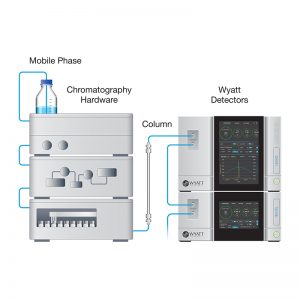
Lignins are ubiquitous cell wall components found in all vascular plants. They are biopolymers whose abundance in nature is second only to cellulose. Derivatives of lignins, such as lignosulfonates, have many different industrial applications that run the gamut from kraft paper manufacturing to special automotive filters.

Lignin branching, mass and size distribution play an important role in determining the application for which the lignin will be best suited. We find multi-angle light scattering used in conjunction with HP-SEC (SEC-MALS) to be an excellent tool for characterizing these polymers, measuring molar mass and radius, their distributions and moments. MALS does not depend on column calibration with linear polymers (that do not elute in the same manner as branched polymers) and constitutes an absolute method for determining these properties.

DAWN®

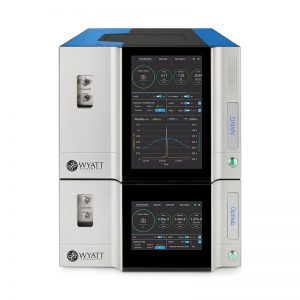
DAWN®

The world’s most advanced light scattering instrument for absolute characterization of proteins, conjugates, macromolecules, and nanoparticles.

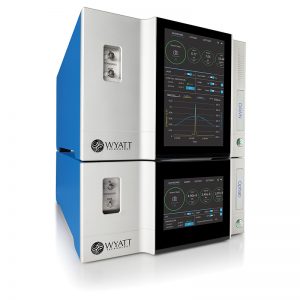
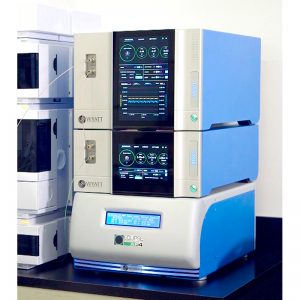
The DAWN and its companion Optilab dRI detector are the established benchmarks for MALS analysis, cited in thousands of peer-reviewed publications. Multi-angle light scattering detection is indispensable for use with GPC and HPLC-SEC in order to obtain reliable molecular mass distributions and information on molecular conformation, branching ratio, fragments and aggregates.

Optilab

Optilab

Universal Detection for Chromatography and FFF Separations

Using a combination of cutting-edge semiconductor photodiode technology and proprietary computer algorithms, the Optilab achieves an unprecedented combination of sensitivity and range. These features mean that it addresses both standard chromatographic applications and some challenges unique to light scattering measurements such as high concentrations, determination of sample refractive increments (dn/dc) and solvent refractive index.